What is missing from Modern Education?
Education is a great concern for every nation of the world, because the students of today will be the citizens of tomorrow. Every government is aware that the quality of the citizens of every generation depends largely on the quality of education they receive. The continued existence of pressing problems in society — including crime, war, economic instability, and disease — makes educators alert and looking for ways to improve the educational system to meet the needs of society.
The decisions people make are based on the way they think, which depends on the functioning of their brain. If people could use their full brain potential, then their thoughts and actions would be most orderly and most conducive to the well-being of society.
If education could develop the full brain potential — the full intelligence — of each of the students, it could provide a means for the progressive elimination of the problems of society, and for maximum progress in all fields.
The Transcendental Meditation and TM-Sidhi programs have been shown to systematically develop the full brain potential of individuals. Additionally, when these programs are practiced in groups (as is done in hundreds of schools today, they produce an influence of positivity and progress for the entire society, as evidenced by reduction of crime, accidents, war casualties, and more.
These scientific research findings show that education now has a means to fulfill its highest goal of creating an increasingly problem-free, healthy, progressive, and fulfilled society.
How are the Transcendental Meditation and TM-Sidhi programs implemented in educational institutions?
To learn more about the implementation of these programs in educational institutions, or to apply to introduce these programs at your institution, please contact the International Foundation of Consciousness-Based Education at CBEfoundation@IFCBE.org
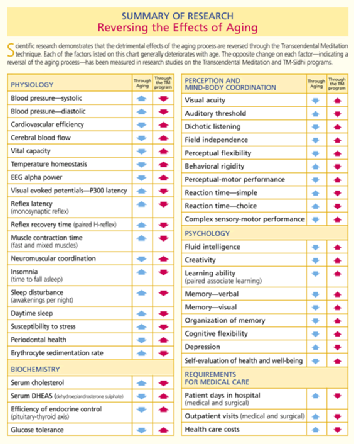
(Click to enlarge)
American Journal of Cardiology 95 (2005), 1060-1064.
International Journal of Neuroscience (16: 53–58, 1982).

Health Benefits